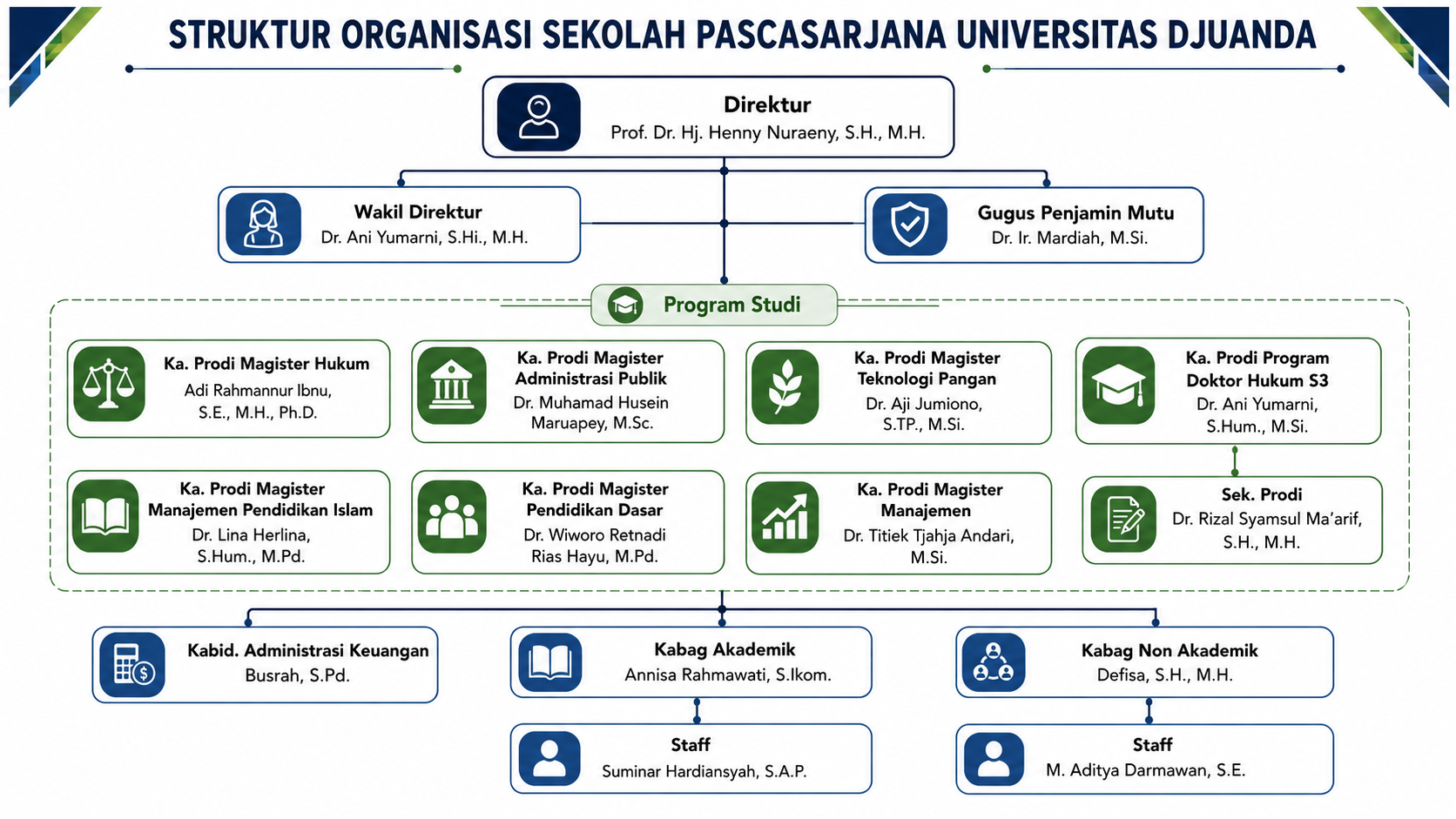
The Postgraduate School of Djuanda University (UNIDA Postgraduate) was established in 2002 with the decision of the Executive Board of the Amaliah Islamic Development Study Center Foundation Number: 001/SK/BP-YPSPA/II/2002 concerning the organizers of the Djuanda University Postgraduate Program, on February 28, 2002. In the same year, the first Master's Program managed by the UNIDA Postgraduate Program was formed, namely the Master of Law Program through the Decree of the Rector of Djuanda University Number: 264/2002 concerning the establishment of the Master of Law Program at the Djuanda University Postgraduate Program, dated September 18, 2002. In 2015, UNIDA Postgraduate has added 2 (two) new study programs including Master of Public Administration and Master of Halal Food Technology and on July 31, 2024 the Postgraduate School officially opened a new study program, namely Master of Islamic Education Management which is expected to be able to meet the needs of the community in the field of education so as to improve the qualifications and skills of its graduates.


To be a post-graduate school that develops science, technology, social sciences, humanities, and education to enlighten the nation, united in monotheism and international standards.
Providing modern graduate education that fosters and develops science, technology, social sciences, humanities, education, and applied sciences integrated within the concept of Tawhid;
Conducting creative and innovative research for the development of science, technology, social sciences, humanities, education, and applied sciences that are integrated in Tawhid;
Conducting community service based on research results in the fields of science, technology, social sciences, humanities, education, and applied sciences that are integrated with monotheism and beneficial to society;
Implementing graduate school management with governance in accordance with the principles of good university governance and international standards;
Building a life centered on Tawhid at graduate school.
Producing graduates of the Graduate School who are devout and internationally competitive in accordance with their scientific fields;
develop modern and international standard academic facilities for the Graduate School.
producing innovative research that is internationally recognized and oriented towards the novelty of science, technology and art, halal and toyib products.
produce community service within the Graduate School that provides problem solving, useful and beneficial to the community.
improve the quality of Postgraduate school governance that is transparent, accountable, independent, equitable and participatory that is united in tawhid.
building a culture of tawhid in every academic and non-academic activity for UNIDA people in the Postgraduate environment
The realization of postgraduate school graduates who are competent in their fields, have faith and are internationally competitive.
The availability of modern Graduate School academic facilities and international standards.
Achieving advanced and renewable findings within the Graduate School that are published, have intellectual property and are recognized.
The realization of downstreaming in the Postgraduate School Environment in the form of business development to support university income and improve the community's economy.
The realization of community satisfaction with service within the Graduate School that is effective and effective.
Dissemination of research results and results of community service within the Postgraduate School The realization of the professionalism of lecturers and education personnel exceeding national standards in the Postgraduate School Environment.
The realization of the professionalism of lecturers and education personnel exceeding national standards in the Postgraduate School Environment.
The realization of godly academics at the Graduate School in the nuances of a godly campus.