
Last Updated: 2 months ago
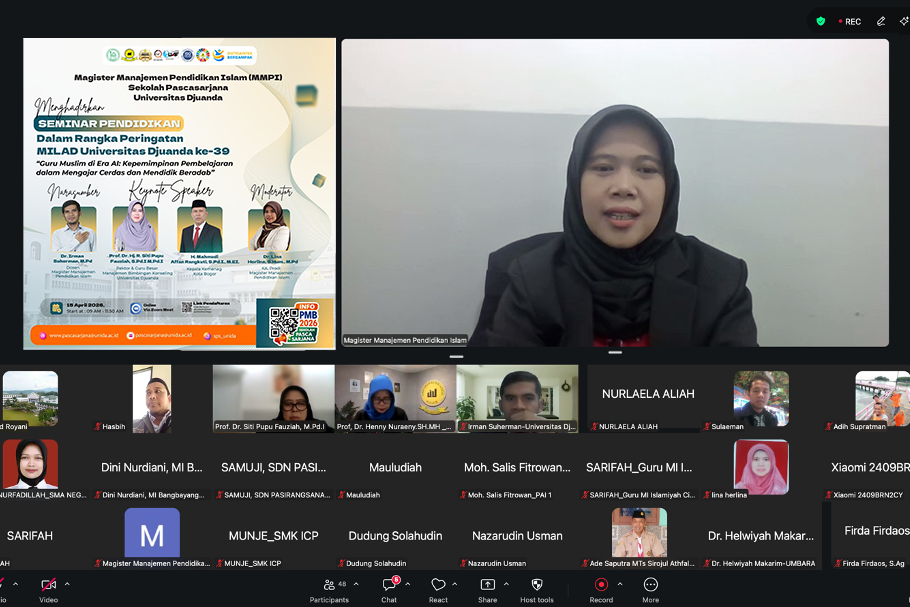
As part of the 39th anniversary celebrations of Djuanda University (UNIDA), the Graduate School, through the Master’s Program in Islamic Education Management (MMPI), hosted an educational webinar on the theme “Muslim Teachers in the AI Era: Educational Leadership in Smart Teaching and Civilized Education” on Wednesday, April 15, 2026.
This event featured UNIDA’s Rector and Professor of Guidance and Counseling Management, Prof. Dr. Hj. R. Siti Pupu Fauziah, S.Pd.I., M.Pd.I., and the Head of the Ministry of Religious Affairs of Bogor City, H. Mahmudi Affan Rangkuti, S.Pd.I., M.E.I., as keynote speakers. Also serving as speakers were UNIDA MMPI lecturer Assoc. Prof. Dr. Irman Suherman, S.Pd.I., M.Pd., AHRA, and Dr. Lina Herlina, S.Hum., M.Pd., Head of the MMPI Study Program, who acted as moderator.
In her opening remarks, the Director of the UNIDA Graduate School, Prof. Dr. Henny Nuraeny, S.H., M.H., stated that the 39th anniversary serves as an opportunity for reflection and for reinforcing the role of education in addressing the challenges of the digital age and artificial intelligence.
Prof. Dr. Henny Nuraeny, S.H., M.H., emphasized that educational transformation should not only focus on the use of technology but also on reinforcing character values and etiquette within the learning process.
“In the era of Artificial Intelligence, teachers are expected to lead the learning process in an adaptive and innovative manner, without neglecting the essence of education as a process of character and etiquette formation,” she said.
Furthermore, Prof. Dr. Henny Nuraeny, S.H., M.H., hopes that this seminar will serve as a platform for collaboration and scholarly discussion among academics and education practitioners in formulating learning strategies relevant to the changing times.
“This webinar is part of UNIDA’s efforts to respond to technological advancements that are increasingly influencing the world of education. Through this initiative, it is hoped that educators, particularly Muslim teachers, will be able to develop adaptive, intelligent, and character-building leadership in learning,” she concluded.
During the keynote session, Prof. Dr. Hj. R. Siti Pupu Fauziah, S.Pd.I., M.Pd.I., explained that advancements in Artificial Intelligence (AI) are driving the education system to become faster, more efficient, and more personalized, while also raising questions about the role of teachers. Prof. Dr. Hj. R. Siti Pupu Fauziah, S.Pd.I., M.Pd.I emphasized the importance of strengthening Guidance and Counseling (BK) to help students develop optimally, reduce dependence on technology, and balance digital intelligence with psychological maturity.
Meanwhile, the Head of the Ministry of Religious Affairs (Kemenag) of Bogor City, H. Mahmudi Affan Rangkuti, S.Pd.I., M.E.I., presented a session titled “The Role of Teachers and Madrasahs in Addressing Educational Transformation in the Era of Artificial Intelligence within the Ministry of Religious Affairs Office of Bogor City.” In his explanation, H. Mahmudi Affan Rangkuti, S.Pd.I., M.E.I., stated that madrasahs need to be adaptive to technology while upholding moral and spiritual values. Therefore, a new role for teachers and institutional strategies are needed that remain rooted in the fundamental values of Islamic education.
The next speaker, UNIDA MMPI Lecturer Assoc. Prof. Dr. Irman Suherman, S.Pd.I., M.Pd., AHRA, presented a session titled “Strategies for Muslim Teachers to Lead Smart and Civilized Learning with the Help of AI.” Assoc. Prof. Dr. Irman Suherman, S.Pd.I., M.Pd., AHRA emphasized that instructional leadership, which is traditionally associated with the role of the principal, is in fact also a fundamental competency of every teacher in the classroom. Teachers act as leaders who guide, diagnose needs, and make instructional decisions to ensure that the learning process runs optimally and has an impact on student achievement.