
Last Updated: 5 months ago
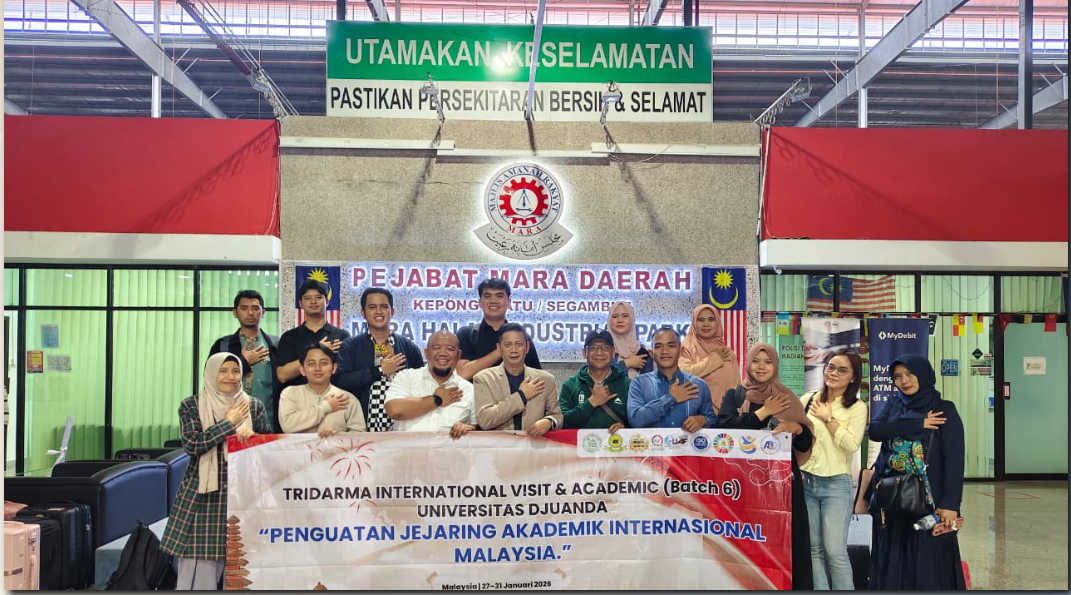
Malaysia, 27 January 2026 – The Djuanda University Postgraduate School conducted an international academic visit to the MARA Halal Industrial Park under the management of the Majlis Amanah Rakyat (MARA), Pejabat Daerah, Malaysia, on Tuesday (27/1). This activity is part of the Tridarma International Visit Batch 6 programme organised at INTEM Malaysia in collaboration with ASEANACA.
The visit focused on strengthening insights into business incubation management, entrepreneurship development, and technological innovation managed in an integrated manner by Malaysian government agencies. The delegation received a direct presentation on the halal industry development ecosystem and innovation-based economic entrepreneurship development strategies.
This agenda is considered highly strategic in supporting the vision of a ‘Campus with Impact’, namely a university that not only excels in academic aspects, but is also able to make a real contribution to society and the industrial world. The implementation of this concept is realised through strengthening research commercialisation, developing campus business incubation centres, and increasing the relevance of graduates to the needs of the global job market.
In addition, this international programme is designed to support the achievement of Higher Education Key Performance Indicators (IKU), specifically:
IKU 3: Lecturers Engaged in Off-Campus Activities
IKU 6: Study Programme Collaboration with World-Class Partners
Through this visit, lecturers and programme heads had the opportunity to discuss directly with the managers of Malaysia's halal industrial zones and government business incubators, thereby opening up opportunities for applied research collaboration, academic exchange, and the development of technology-based entrepreneurship programmes.
The Vice Rector for Academic and Student Affairs at Djuanda University, Dr Aal Lukmanul Hakim, S.H., M.H., emphasised that the delegation's presence in Malaysia was a form of the institution's commitment to improving academic quality to a global level.
This activity is a concrete step taken by Djuanda University in expanding its international network, particularly to strengthen postgraduate and doctoral education. We want to ensure that the learning process, research, and community service are directly connected to the best practices at the global level,’ he said.
Prof. Dr. Hj. Endeh Suhartini, S.H., M.H., Director of the Djuanda University Postgraduate School, said that the academic visit to MARA Halal Industrial Park Malaysia was a strategic step in broadening the global perspective of postgraduate academics. According to her, the experience of seeing first-hand the management of an innovation-based halal industry and government support provides an important perspective for strengthening applied research, curriculum development, and international collaboration that has a real impact on society and the industrial world.
Meanwhile, Dr. Lina Herlina, S.Hum., M.Pd, Head of the Islamic Education Management Master's Programme at Djuanda University, one of the lecturers representing the Postgraduate School during the visit, explained that the management model implemented by MARA is highly relevant to the development of Islamic education management based on entrepreneurship and community empowerment.
According to her, MARA not only functions as an economic institution but also as a human resource development institution that integrates education, training, character development, and business support into a sustainable ecosystem.
‘MARA's approach is very inspiring for the development of Islamic education management because it combines professional institutional governance with a mission of community empowerment. The business incubation concept that they implement can be adapted in the context of Islamic educational institutions to encourage the emergence of graduates who are not only academically competent but also economically independent and have a spirit of social entrepreneurship,’ explained Dr. Lina Herlina.
She added that this study opens up new insights into the management of Islamic educational institutions to be more adaptive to the challenges of the times, particularly in building strategic partnerships, programme innovation, and strengthening impact-based governance.
In addition, MARA is relevant to various study programmes at the Djuanda University Postgraduate School. A visit to MARA (Majlis Amanah Rakyat) provides an interdisciplinary perspective as this institution integrates education, public governance, entrepreneurship, the halal industry, and community empowerment into a single development ecosystem. Here is how it relates to each study programme:
1. Master of Law
MARA's halal industrial estate management model is closely related to industrial regulations, halal consumer protection, business law, and sharia-based public policy. This is relevant to the study of economic law, state administrative law, and regulatory governance in supporting the halal industry ecosystem.
2. Master of Public Administration
MARA is an example of good governance practices in the public sector in community economic empowerment. The programme planning system, business incubator management, and synergy between the government and business actors are real-world studies in public policy management and impact-based public service innovation.
3. Master of Food Technology (Halal Food)
MARA Halal Industrial Park is highly relevant to the development of halal supply chains, certification standards, food safety, and food technology-based product innovation. This opens up opportunities for applied research collaboration in the development of competitive halal products in the global market.
4. Master of Primary Education
The MARA human resource development model emphasises the importance of strengthening character, life skills, and entrepreneurial spirit from an early age. This can serve as inspiration in developing a more contextual and future-oriented primary education curriculum and management.
5. Master of Management
The business incubation ecosystem and innovation-based MSME development at MARA are relevant to the study of strategic management, entrepreneurship, innovation management, and sustainable business development. This is a concrete example of the application of management theory on a national scale based on government support.
6. Doctor of Law Perspective on the MARA Model
From a Doctor of Law perspective, MARA (Majlis Amanah Rakyat) represents a concrete practice of how the state uses legal instruments to promote social justice through economic and educational empowerment. MARA not only functions as an administrative institution, but also as an embodiment of public policy law designed to strengthen public access to education, business financing, and the development of strategic industries such as the halal industry.
Overall, MARA represents an integrative model between education, public policy, and industrial development, which is very much in line with the spirit of the Impactful Campus being developed by the Djuanda University Postgraduate School.
This visit is expected to mark the beginning of ongoing cooperation between Djuanda University and strategic institutions in Malaysia in the fields of education, research, and entrepreneurship development based on Islamic values and global benefits.