
Last Updated: 6 months ago
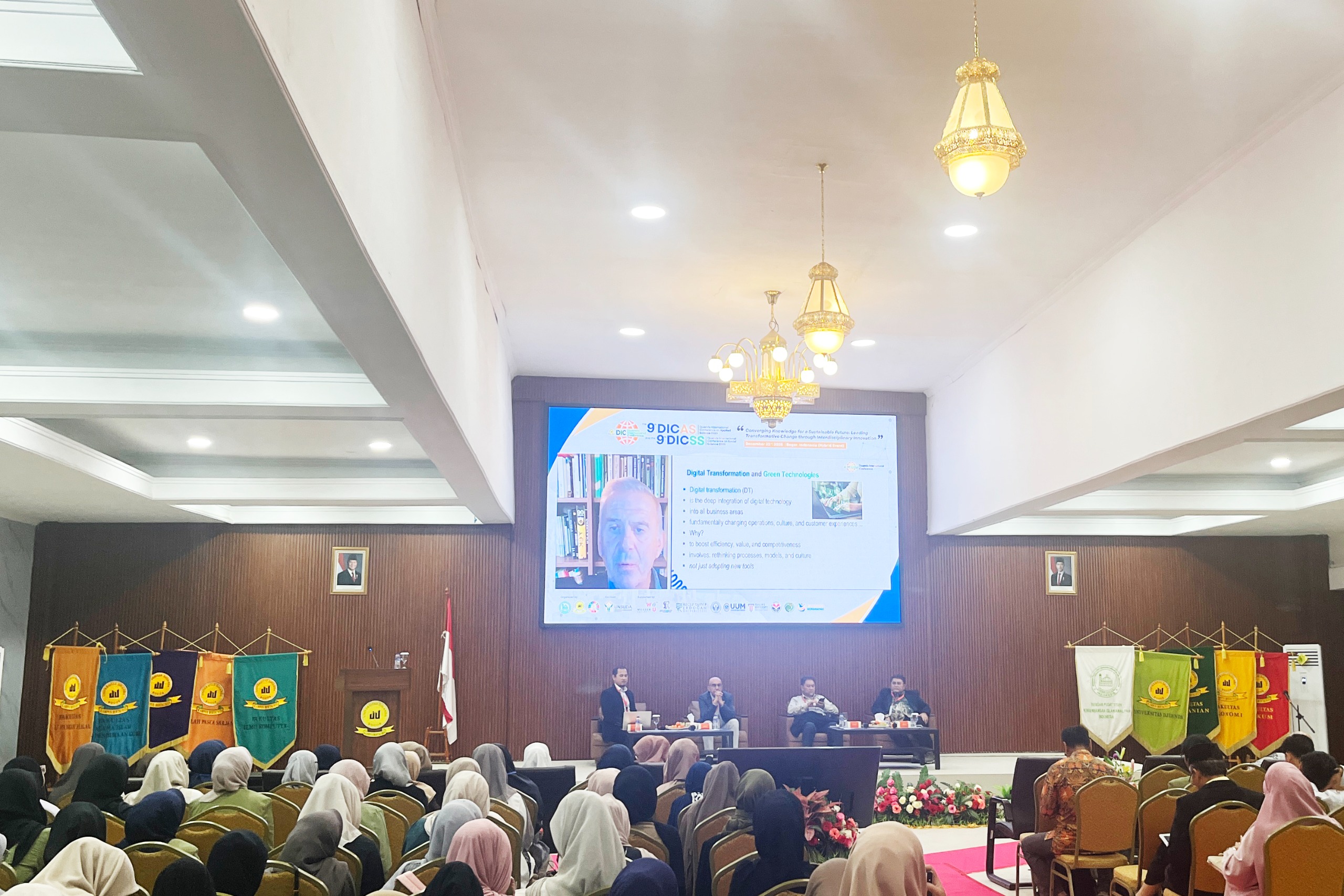
Digital transformation and green technologies are regarded as two interconnected forces driving sustainable growth in the global era. This perspective was presented by Prof. Dr. Dimitrios Maditinos of Democritus University of Thrace, Greece, as one of the international speakers at The 9th Djuanda International Conference on Applied Science (DICAS) and The 9th Djuanda International Conference on Social Sciences (DICSS), organized by Universitas Djuanda (UNIDA).
The conference was held in a hybrid format on Monday (22 December 2025) at the Auditorium of Building C, Universitas Djuanda, as part of the commemoration of Nusantara Day or the Djuanda Declaration, a historic milestone affirming Indonesia’s maritime identity and sovereignty.
In his presentation entitled “The Role of Digital Transformation and Green Technologies in Advancing Sustainable Growth,” Prof. Dimitrios explained that digital transformation refers to the deep integration of digital technologies into all aspects of organizations and economic systems. This process involves changes in work practices, organizational culture, and data-driven decision-making, with the aim of enhancing efficiency, value creation, and competitiveness.
He emphasized that digital transformation is not merely about adopting new technologies, but rather about restructuring operational models and long-term strategies. The utilization of artificial intelligence, cloud computing, the Internet of Things (IoT), and data analytics was highlighted as crucial in improving accuracy in planning and managing economic and environmental systems.
Alongside digital transformation, Prof. Dimitrios underlined the strategic role of green technologies as concrete solutions to global challenges such as climate change and environmental crises. Renewable energy, low-carbon infrastructure, circular economy models, and sustainable construction were identified as essential foundations for a more environmentally friendly future.
According to him, digital transformation and green technologies do not operate independently but instead reinforce one another. Digital technologies provide intelligence and precision, while green technologies deliver tangible impacts on sustainability. The convergence of these two forces creates a new model of economic growth based on resilience, intelligence, and environmental responsibility.
Prof. Dimitrios also shared best practices from Europe and Asia in the development of smart cities, sustainable manufacturing, electric transportation, and modern energy systems. He noted that Europe excels in regulatory frameworks, standards, and cross-country coordination, while Asia demonstrates strengths in rapid technology adoption and large-scale implementation.
“These differences in approach open significant opportunities for mutual learning and collaboration in building a sustainable global future,” he stated.
Concluding his presentation, Prof. Dimitrios called on leaders, academics, and stakeholders to strengthen cross-border and cross-sector collaboration. He emphasized that future generations will assess sustainability commitments based on concrete actions taken today, rather than on intentions or discourse alone.
As additional information, The 9th DICAS & The 9th DICSS, organized by Universitas Djuanda, carry the theme “Converging Knowledge for a Sustainable Future: Leading Transformative Change through Interdisciplinary Innovation.” The conference serves as a strategic forum for academics, researchers, practitioners, and policymakers from various countries to exchange ideas, research findings, and interdisciplinary innovations, while reinforcing the spirit of the Djuanda Declaration in addressing global challenges of sustainable development.
A number of international academics and researchers participated as speakers, including Prof. Dr. Naim Demirel (Recep Tayyip Erdoğan University, Türkiye), Prof. Dr. Ravinder Rena (School of Business, Woxsen University, Hyderabad, India), Prof. Dr. Eng. Asep Bayu Dani Nandiyanto (Universitas Pendidikan Indonesia & Hiroshima University, Japan), Prof. Dr. Necmettin Marasli (Istanbul Gelisim University, Türkiye), Prof. Dr. Nuarual Hilal Md (Universiti Utara Malaysia), Assoc. Prof. Dr. Abdulkareem Sh. Mahdi Al-Obaidi (Iraq/Taylor’s University, Malaysia), and Assoc. Prof. Dr. Yudi Wahyudin, S.Pi., M.Si. (Universitas Djuanda, Indonesia).